How do I use Roku Media Player to play my videos, music and photos?
Roku Media Player is a channel available for download through the Roku Channel Store. It may also be pre-installed on some Roku® streaming devices. Roku Media Player allows you to watch your own personal video files, listen to your music files, and view your photos using the Roku device’s USB port (if available) or by accessing a media server on your local network.
Playing content stored on a USB drive
Some Roku devices include a USB port to which you can connect an external USB drive for the purpose of playing locally stored photo, audio, and video files. You can connect more than one USB drive to your Roku device by connecting them to a USB hub.
You can use the Roku device comparison chart to determine which current products include a USB port.USB drives may be formatted with different file systems. Roku Media Player supports drives that are formatted with the FAT16, FAT32, NTFS, EXT2, EXT3, and HFS+ file systems. You can also access different partitions on the USB drive.
Insert the USB device into the USB port on your Roku device. If Roku Media Player is not installed, you will be prompted to add it from the Roku Channel Store. If the channel is installed, an on-screen prompt will ask you to launch Roku Media Player.
- Note: You can change the behavior of the channel when a USB device is inserted by visiting Settings > System > USB media.
If you are in Roku Media Player when the USB device is inserted, a USB Drive icon should show up in the media device selection screen.
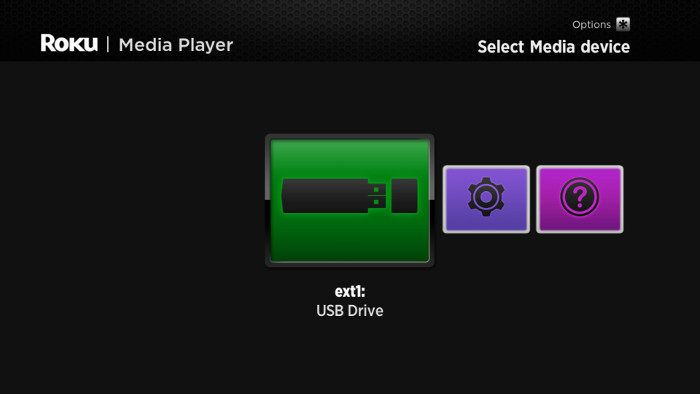
You can access this screen by selecting All from the main screen. If you do not see the icon, learn what to do if Roku Media Player does not detect the USB device.
Playing content on your local area network
DLNA (Digital Living Network Alliance) is a standard technology that enables sharing of content between devices connected over a network. To play content stored on another device or computer on your Roku device using DLNA, the other device must be running DLNA server software and must be on the same network as your Roku device. Some routers and NAS (Network Attached Storage) devices have a built in DLNA server.
Roku Media Player has been tested to work with the following DLNA servers:
- Windows Media Player/Center
- Serviio
- Plex
- Twonky
- MiniDLNA/ReadyDLNA/ReadyMedia
- PlayOn
For information on setting up a DLNA server, consult the associated online support site.
Supported media file types
Different Roku devices support different formats. Newer firmware may support additional formats. The type of audio formats supported is dependent on the type of TV or A/V receiver your Roku device is connected to. Formats supported by your Roku device can be viewed by accessing the ?/Help pages from the Media Device and the Media Type selection screens.
The following file formats are supported:
- Video – H.264/AVC (.MKV, .MP4, .MOV)
- Audio – AAC (.MKV, .MP4, .MOV); MP3(.MP3, .MKV); WMA (.ASF, .WMA, .MKV), FLAC (.FLAC, .MKV), PCM (.WAV, .MKV, .MP4, .MOV), DTS (.MKV, .MP4, .MOV,.DTS), ALAC (.MKV, .MP4, .MOV, .M4A), Vorbis (.OGG,.MKV,.WEBM)
- Playlists –.M3U, .M3U8, .PLS
- Image – JPG, PNG, GIF (non-animated)
The following media formats are supported on Roku devices that support 4K
- 4K Video – H.265/HEVC (.MKV, .MP4, .MOV); VP9 (.MKV, .WEBM)
- 4K Video – H.264 (Roku Premiere, Premiere+, and Ultra only)
The following media formats are supported on Roku TVs
- Video – H.262 (.MKV)
Notes:
- The Roku Media Player channel will not display unsupported file types or files it has determined cannot be played by your Roku device.
- DRM-protected content is not supported.
Support for 5.1 AC3/E-AC3 (Dolby Digital)
Most Roku players cannot decode Dolby Digital™ (AC3) or Dolby Digital Plus™ (E-AC3). If you are trying to play Dolby Audio™ (AC3, E-AC3) but do not hear multi-channel surround sound, try connecting your Roku player via HDMI® or S/PDIF (optical) to a TV or AVR capable of decoding Dolby Audio™. Your Roku player will pass through the encoded Dolby Audio to the TV or AVR for decoding.
Some Roku players can decode Dolby Digital Plus to HDMI and S/PDIF TOSLINK (optical). This means that content encoded with Dolby Digital Plus will be transcoded (converted) into Dolby Digital if your A/V receiver does not support Dolby Digital Plus, but does support Dolby Digital 5.1.
Check your Roku device specifications to determine its audio capabilities.
Roku TVs support transcoding Dolby Digital Plus to Dolby Digital for the S/PDIF (optical) and ARC (Audio Return Channel) connectors, allowing you to connect your TV audio to an A/V receiver (AVR) that supports Dolby Digital 5.1 (but not Dolby Digital Plus).
Note: Dolby TrueHD and lossless Dolby are not supported.
Support for 5.1 DTS (Dedicated To Sound)
Roku devices will only pass through DTS audio. To decode multi-channel surround sound, you must connect your Roku device via HDMI or S/PDIF (optical) to a TV or A/V receiver capable of decoding DTS.
Note: DTS-HD and lossless DTS are not supported.
Support for AAC (Advanced Audio Coding)
Roku devices do not support AAC pass-through. Instead, Stereo AAC is transcoded to PCM stereo.
Roku TVs and some Roku players decode 5.1 AAC to PCM stereo for headphone, internal speaker, and HDMI/ S/PDIF (optical) output. However, Roku devices that support Dolby Audio decode connected via HDMI or S/PDIF (optical) to an A/V receiver that also supports Dolby Audio, will convert the audio to Dolby Digital 5.1.
You can use the product comparison chart to determine which current products support Dolby Audio decode via HDMI and optical.How to play music or video using Roku Media Player
- Select the media type from the Media Type Selection screen.
- Choose the device that has the content you wish to play.
- Navigate through your folders to find the content you wish to play. If the desired file is in an unsupported file format, then it will not be displayed.
- When you find the content you wish to play press the OK button
 or Play button
  .
. - While playing, you can pause, skip forward and skip backwards using the Play/Pause button , Forward Scan button
 and Reverse Scan button
  on your Roku remote control.
- Note: Not all files support fast-forward and rewind.
- Note: Not all files support fast-forward and rewind.
- To stop playback, press the Back button
 .
.
Tips:
- To play all the videos/music in a folder as a playlist, press the Play button when the folder is highlighted.
- Options for playback and browsing like speed and shuffle can be accessed by pressing the Star button
 on your Roku remote.
 - Options for audio playback can only be accessed while playing audio content.
- Options for video playback can only be changed when viewing the video details screen.
- Options for photo playback can only be accessed while a slideshow is running.
Convert videos to play with Roku Media Player
Some DLNA servers, such as Plex and Serviio, will automatically convert (transcode) the video to a format supported by the Roku device. If you are using a DLNA server that does not support transcoding, or you are playing directly from a USB drive, you may need to convert the files first. There are several applications available for converting videos. Follow the link to get the encoding settings for Handbrake, one of the more popular video conversion applications.
Provide your own poster artwork for videos on a USB drive
You can add your own artwork for a video by creating a JPG or PNG file with the same name as the video, and copying it to the same folder as the video on the USB drive.
Support for movie subtitles
Roku Media Player supports embedded subtitles in .mkv files. To choose a subtitle track use the Star button while the video is playing. Roku Media Player will automatically include subtitle tracks found in .SRT and .VTT files. The files must be saved in the same folder as the video. They must have the same name as the video and the .srt or .vtt extension. To include multiple files you must insert a language extension, for example movie.eng.srt or movie.ger.srt.
Support for playlists
Roku Media Player supports .pls, .m3u and .m3u8 playlists on a USB drive. The media in the playlist should have an extension that indicates the media type, for example .mp3, .mkv, .jpg, etc. Playlist entries can also point to a URL. Make sure the URL begins with http:// and the extension should indicate the media type. If the playlist entry does not have a recognizable extension, it will be treated as a video and will try to detect the actual media type when it starts playing. Some DLNA servers will convert playlist files to folders that the Roku Media Player can access using DLNA.
Creating USB drive that will auto start a slideshow, music playback, or a movie.
Create a playlist file called Autostart.m3u in the root of the USB device. Put entries in that file that point to the media you want automatically played on your Roku. Set the Roku to auto-launch Roku Media Player when a USB device is inserted by going to the Settings > System > USB media menu. If you want to disable automatic playback, you can disable it the main Settings menu of Roku Media Player.
Change the number of posters in a row
- From the main screen, select All to go to the Select Media device screen.
- Select the Settings icon.
- Go to the Display format row.
- Pressing the OK button will toggle between Long (50) or Short (4 posters per row).
- Press the Back button or select OK to dismiss the Settings screen.
Disable album artwork lookup when accessing mp3 files on a USB drive
You can change whether the USB player attempts to find album artwork on the web when reading .mp3 audio files. This can significantly speed up going into a folder with lots of audio files.
- From the main screen, select All to go to the Select Media device screen.
- Select the Settings icon.
- Go to the Lookup album art on Web row.
- Pressing the OK button will toggle it On and Off.
- Press the Back button or select OK to dismiss the Settings screen.
Disable the Media Type selection screen at startup
- From the main screen, select All to go to the Select Media device screen.
- Select the Settings icon.
- Go to the Request media type at startup row.
- Pressing the OK button will toggle it On and Off.
- Press the Back button or select OK to dismiss the Settings screen.
Dolby is a registered trademark of Dolby Laboratories.
Last updated at 2/25/2026 5:32:57 AM
Was this article helpful?
Related articles
Need more help?